What is Proposition B in San Antonio? KSAT Explains

A confrontation ends with a civilian killed by a police officer. Outrage and protests follow. Then calls for accountability.

And then it happens again, in some other city in the United States.

To many it seems we’re stuck in a cycle. It’s why activists in communities across the nation are calling for police reform. And it’s why when you vote in the May 1 election, you’ll have the chance to vote for or against Proposition B.

By now, you’ve probably heard about the effort to repeal San Antonio police officers’ collective bargaining power. But there have been mixed messages on the issue, leading to confusion for voters. In this episode of KSAT Explains, we’re explaining what Prop B is all about, the arguments for and against it, and what it would and wouldn’t accomplish if passed. (Watch the full episode in the video player above.)

SMART. IN-DEPTH. LOCAL: Click here for more episodes of KSAT Explains

What is Prop B?

Last summer, local woman Oji Martin founded a group called Fix SAPD. Martin said she reached her tipping point after the death of George Floyd in Minnesota and after watching Broken Blue, the KSAT special on misconduct and disciplinary procedures within the San Antonio Police Department.

With the goal of reforming the police department, the group launched two petition drives to get two items on the May ballot. The ultimate goal was to repeal two local government codes that, among other things, provide protections for police officers under investigation.

“There is lack of accountability in our police system, and that’s what’s causing all these issues,” said Martin when KSAT talked to her about the petition drive in September.

Ultimately, Fix SAPD only amassed enough signatures to get Prop B on the ballot — the proposed repeal of Texas Local Government Code Chapter 174. They are still working on the petition drive to repeal 143.

Chapter 174, explained

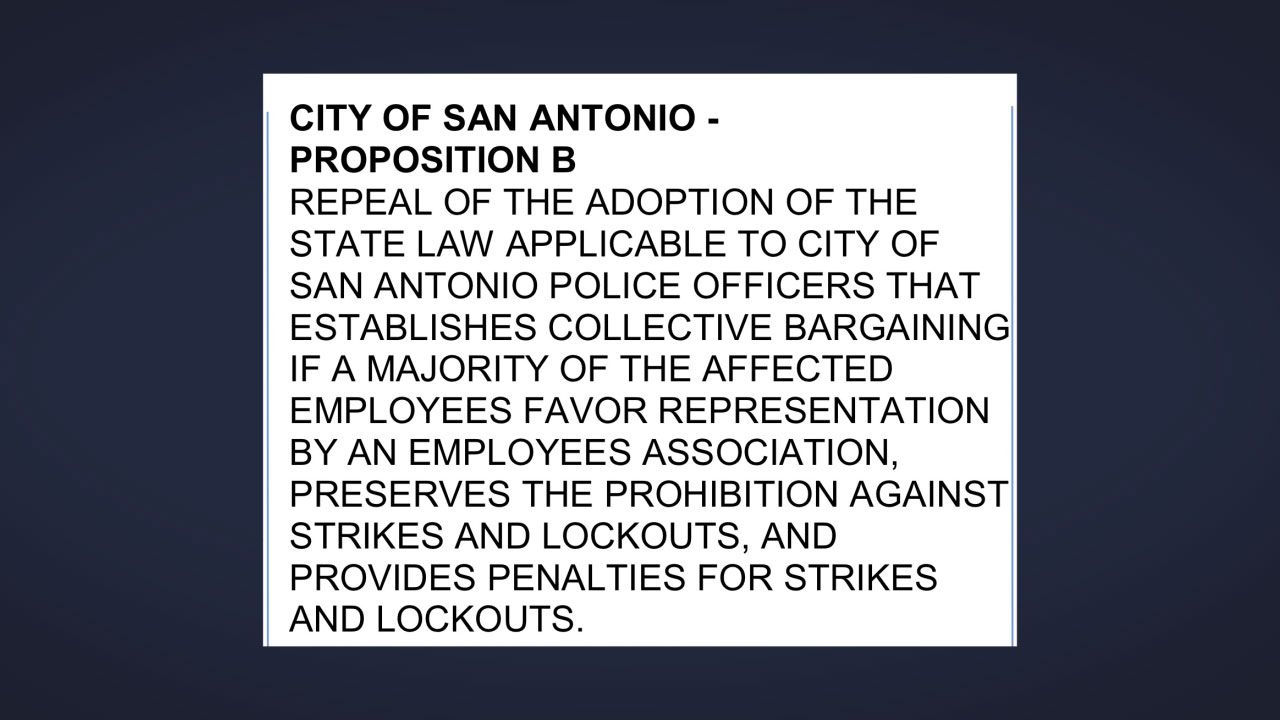
This is what Prop B looks like:

As is the case with a lot of ballot initiatives, the wording itself is confusing. It calls for the repeal of Chapter 174, which allows police unions to collectively bargain while keeping in place the rule that says officers can’t strike or stage a lockout.

Collective bargaining is a process in which a union and their employer, in this case the city, determine wages, hours and working conditions for all the employees the union represents: police officers. It’s contract negotiations. And right now, it’s a major debate.

Fix SAPD said they decided to go after collective bargaining, because they believe a lot of the issues with police accountability start with the contract.

“You just follow the breadcrumbs and you realize bad contracts lead to poor performance by some of these officers,” said Fix SAPD board member EJ Pinnock. “These contracts are set up by certain laws. In this case, state laws. And Prop B allows us to go ahead and change all of those things.”

Defunding?

Fix SAPD believes voting yes on Prop B is a step toward more accountability. But the San Antonio Police Officers’ Association has labeled a vote for Prop B a vote for defunding the police.

“Defund the police” became a national rallying cry in the wake of protests for police reform. It means reallocating funding from police departments to other government agencies.

But Prop B would not directly affect the budget of SAPD in any way.

Still, SAPOA President Danny Diaz argues that defunding would be the ultimate effect. Diaz says that because doing away with collective bargaining would remove one negotiating tool from the union, which he says would threaten competitive benefits for officers.

Fix SAPD calls the defund label for Prop B a scare tactic.

Of the eight largest cities in Texas, only San Antonio, El Paso and Corpus Christi use collective bargaining.

The union has questioned why Fix SAPD is targeting collective bargaining in the first place, instead of specific parts of the police contract they take issue with.

“Why did they not go after Articles 28 and 29,” Diaz said. “That’s what deals with our discipline.”

But we checked with the city. And according to the San Antonio City Attorney, Fix SAPD couldn’t put the contract to a city-wide vote.

So the process of negotiating that contract is in the group’s crosshairs.

How many officers have gotten their job back because of arbitration?

For years, certain aspects of the police union’s contract have been questioned.

One major sticking point — arbitration. Under the current contract, an officer fired by the police chief can have a third-party arbitrator determine whether they should get their job back.

The union argues arbitration has rarely given an officer his or her job back. They say it’s happened 10 times over 10 years. Fix SAPD says 70 percent of all SAPD officers fired get their jobs back.

This back and forth has been a huge point of contention in this debate. So which stat is true?

KSAT crunched the numbers. Here’s what we found:

From 2010 to the summer of 2020, there were 71 police officer terminations. Some of those cases are still pending. In 43 cases, the officer appealed their termination and a decision was made whether to put that officer back on the job. Ten of those officers got their jobs back through arbitration. Twenty were brought back by the police chief, which in some cases happens because it becomes too expensive for the city to uphold an officer’s firing through the arbitration process.

This amounts to 69.8 percent of fired officers who appealed their terminations being brought back to the force from 2010 to summer 2020.

What else is in the police contract?

It’s not just arbitration that’s been highlighted as one of the aspects of the collective bargaining agreement that needs a closer look.

Here are a few other often criticized items in the police contract:

The police chief can only discipline officers for up to 180 days from the date of a violation.The police chief can’t consider misconduct older than 10 years for drug and alcohol violations, and older than five years for violent violations, during the disciplinary process.The current contract allows officers accused of wrongdoing to get 48 hours notice before speaking with internal investigators.

Some of these issues are being discussed between the union and the city as they’re negotiating right now. The current contract is set to expire in September. The union argues they’re already talking about possible changes, so why rid them of collective bargaining?

But Chapter 174 is only the first step in Fix SAPD’s plan to reform the police department.

What is Chapter 143?

San Antonians adopted Chapter 143, or “civil service,” in 1947. It’s a broad law that lays out how a city handles personnel issues for firefighters and police officers. It covers things like hirings, promotions and benefits. It does not, however, address officer pay.

Without collective bargaining, a contract between the city and union is not required. City staff and the city manager would recommend officer pay and benefits, and the city council would vote whether to approve.

But 143 does cover firings and the process used for discipline. And because it is in place, even if Chapter 174 is repealed in May, police would still have protections in place.

What does Chapter 143 say about firings and discipline?

When it comes to hiring, firing and discipline — think of Chapter 143 as a baseline. If a collective bargaining agreement goes away, 143 spells out how to proceed. A lot of those rules are the same or similar to the rules spelled out in the current contract between the city and union.

For example, under 143 a hearing examiner can make a ruling if an officer appeals a termination. Similar to arbitration.

Chapter 143 also says only the police chief can view an officer’s personnel file, not the media or the general public. And it says the police chief can’t suspend an officer for an offense that happened more than 180 days ago. Which is also in the current contract.

That’s why Fix SAPD wants Chapter 143 to be repealed, too. But organizers say repealing 174 is the first step.

But Chapter 143 is a tougher target. Fix SAPD got the more than 20,000 signatures needed to put 174 in front of voters. Repealing 143 requires roughly 80,000 signatures collected in 180 days.

Julia Gannaway, an attorney who represents Texas cities in negotiations and civil service issues, said to her knowledge no city has been successful in repealing 143.

“143 is like the Hotel California,” Gannaway said. “You can check in any time you like, but you can never leave. You can’t get out of it.”

What is meet and confer?

If collective bargaining is repealed in May, the police union and city could still negotiate a contract under what’s known as a “meet and confer” system.

Think of it as collective bargaining light. It can still bring both sides to the negotiating table. But they don’t have to if they don’t want to.

The police union has to agree to meet and confer and petition the city. Then city council has to approve it, or they could let voters decide.

Fix SAPD supports meet and confer and points to the city of Austin as an example.

“In Austin, they actually have better pay, better benefits and they have a meet and confer system,” said Fix SAPD board member James Dykman during a Prop B debate held by KSAT, San Antonio Report and Bexar Facts. “We can still attract great officers to the city as they do.”

Crime, pay, civilian oversight

Are crime rates skyrocketing in Texas? Would San Antonio police officers lose competitive pay under a meet and confer system? Would civilians have more oversight if Prop B passes? Watch the video below for clarification on some of the biggest questions surrounding the Prop B debate.

Want to know more about San Antonio’s history and future as a brew town? KSAT Explains

Whether you prefer a pilsner, a porter or a pale ale, it seems these days there’s a brewery in San Antonio for everyone. While you may think this local beer explosion is recent, our city has a history as a brew town that dates back more than 150 years.

But it’s a history that’s undoubtedly been filled with ups and downs.

In this episode of KSAT Explains, we take a look back at our city’s stories beer history, and the changes in Texas laws that are helping the industry thrive. (Watch the full episode in the video player above.)

SMART. IN-DEPTH. LOCAL: Click here for more episodes of KSAT Explains

‘Germans are thirsty people’: San Antonio’s deep roots in the beer industry

San Antonio has some awesome beer. And we can thank the German, Austrian and Czech immigrants who settled in the San Antonio area in the mid-1800s.

“Germans are thirsty people,” said San Antonio brewery historian Charlie Staats. “They like their beer.”

Cost was an incentive for immigrants to brew their own beer, he said. Since other breweries were out of state, beer took a long time to arrive in San Antonio and was very expensive. With the San Antonio River in their backyards, German immigrants decided to start making their own.

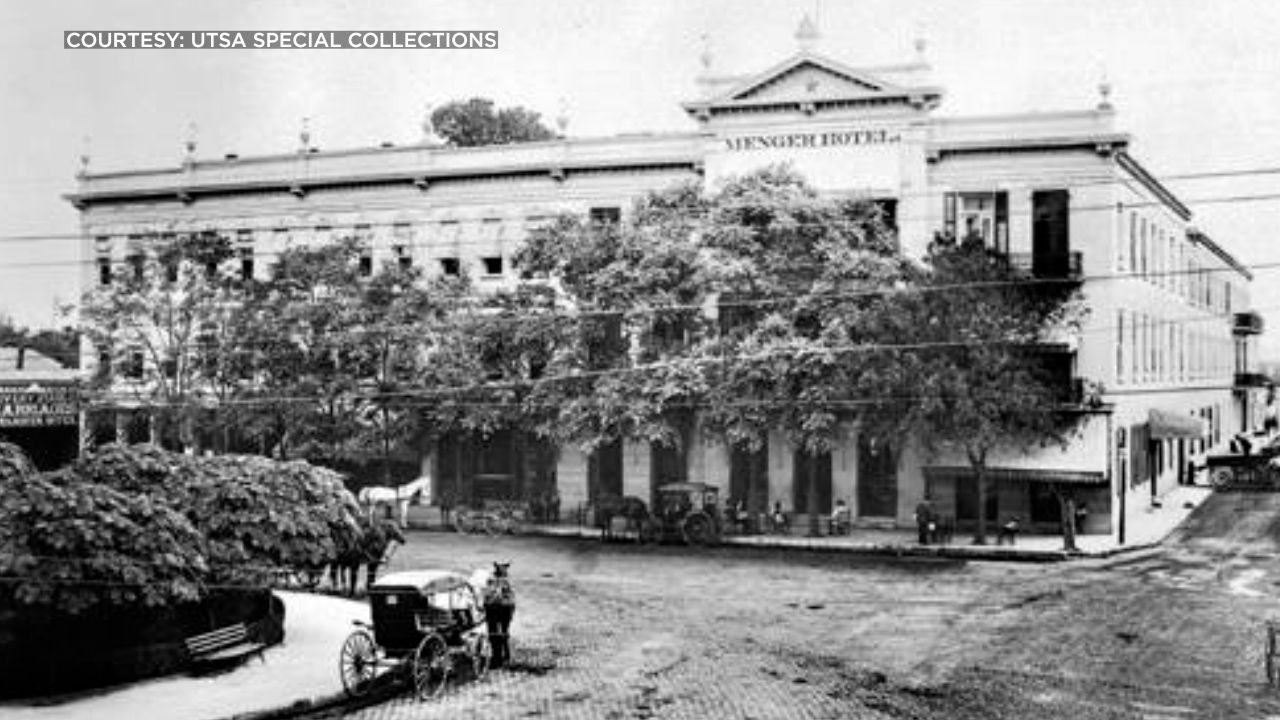
When people think of San Antonio beer history, they often think of Pearl. But Pearl is just a piece of our city’s brewing past. The Alamo City’s beer history all started at a hotel still popular here in San Antonio — The Menger.

Before he opened The Menger Hotel, German immigrant William Menger owned a brewery that distributed beer not only in San Antonio, but as far west as San Angelo, as far east as Galveston and down into the Rio Grande Valley.

The brewery was so popular, customers often crashed there or at Menger’s boarding house next door. So Menger expanded the boarding house and opened his hotel in 1859. His brewery moved underneath it.

The brewery maintained popularity well into the Civil War Era.

Menger’s brewery was in business until 1878. That year it was considered one of the largest beer producers in Texas.

Around this time period, there were dozens of breweries in the San Antonio area. Many didn’t survive because of competition from beer giants Budweiser and Anheuser-Busch.

A brief History of Pearl Brewery

The Pearl Brewery didn’t get its start until 1883, and was originally known as The San Antonio Brewing Association.

But as years went by, the brewery would go through different names and different owners until, in 1952, it was finally given the name we know it by today.

Pearl beer got its name after a brewmaster said the bubbles of the beer looked like sparkling pearls when poured into a glass.

By 1916, The Pearl would grow in popularity and become the largest brewery in Texas. But the business would soon face a series of challenges.

When the 18th Amendment was ratified on January 17, 1920, alcohol became illegal in the United States, and it nearly killed the brewing industry, closing Texas beer giant Lone Star, among others.

On top of that, the owner of the Pearl Brewery Otto Koehler died. His widow, Emma Koehler, was quick to adapt. Pearl started making orange sodas, ice cream and malts.

“They’re using every piece of the equipment that was part of the brewing process and part of maintaining a manufacturing facility to kind of keep this thing going during Prohibition,” said Travis Poling, co-author of San Antonio Beer: Alamo City History by the Pint. “They were the first brewery actually in the entire Southwest to reopen when Prohibition lifted.”

After Prohibition, during the Great Depression, Emma Koehler had to rethink everything again.

She sold the soda bottling portion of the brewery and began making full-strength beer again, staying afloat by selling it to anyone who could afford it.

This not only helped The Pearl stay alive, but would cause it to be a top-selling beer after World War II.

But, once again, bigger beer brands gained popularity throughout the country, including Texas. And in 1968, Pearl brand beer was at the bottom of most people’s lists.

Pabst took over the Pearl brewery in 1985, and it would close its doors for good in 2001.

Pearl beer is still owned by Pabst, and as of last summer, the beer is brewed in Austin.

Watch the video below to learn more about San Antonio’s early breweries:

With all of its heavy hitters bought out, and moved to different areas of Texas, it looked like the San Antonio beer scene was coming to an end.

‘People in Texas always liked beer’: Local beer returns to San Antonio

When it comes to beer legislation, Texas has historically been behind the curve. But over the past 20 years, there have been several pieces of legislation that have helped the beer industry boom.

In 1993, Texas legalized brewpubs — establishments that sell beer brewed on the premises and often include a restaurant. At the time, brewpubs were already legal in 41 states. Texans were quick to jump on the trend.

“People in Texas always liked beer,” said Dustin Baker, owner of Roadmap Brewery. “They’ve always liked good beer.”

A familiar face in the local craft beer scene, Jason Davis got his start in the industry soon after brewpubs became legal. He worked at the first brewpub in Texas, Waterloo. He also worked at the oldest brewpub in San Antonio, Blue Star.

But in 2008, Davis helped launch the brewery where he still serves as director of brewing operations today — Freetail. Over the past 13 years, the business has exploded. And the brewery’s founder, Scott Metzger, was instrumental in working alongside the Texas Craft Brewer’s Guild to help change even more laws to further the beer industry in the state.

2013 was a big year for change.

A series of bills passed in the Texas Legislature made the state more beer business-friendly. For the first time, brewpubs could sell their beer to grocery stores and restaurants. A new law also allowed microbreweries to actually sell beer in their tap rooms. Previously, they were limited to giving away free beer samples on tours.

After another piece of legislation passed in 2019, Texans can now buy a six-pack of beer directly from a craft brewery.

All of these fairly new laws have helped many smaller breweries develop and become more popular throughout Texas and San Antonio.

Click through the slideshow below to learn more about some of San Antonio’s most popular breweries:

‘We’re not an industrial economy anymore’: New life for old breweries

Over the past several years, we’ve seen developers breathe new life into abandoned breweries. The most obvious example of this is what has happened to the old Pearl Brewery.

Pabst closed the brewery in 2001. That same year, the 23-arce property was bought by Silver Ventures. Today the sight is a popular hang-out spot — home to shops, restaurants, apartments and a hotel.

Less than a mile south of the Pearl is the old Lone Star Brewery building, which is now the San Antonio Museum of Art. It opened in 1981, years after the brewery closed during Prohibition.

And then there’s the other Lone Star Brewery — the brand that’s still popular today. Operations stopped at the South Side plant in 1996. But now there’s a new plan for the spot.

Gray Street Partners, a local real estate investment group, has been looking to fund a new project that would rework the space — building retail space, restaurants, apartment buildings, and a park, complete with a walking path.

“Every city is kind of going through the same process of thinking about what do we do with this old industrial space because we’re not an industrial economy anymore,” said Christine Drennon, Ph.D., Director of Urban Studies at Trinity University.

Experts say that redeveloping these buildings has many environmental benefits, by using buildings that already exist instead of building new ones. But even though these mixed-use developments we see today create jobs, they don’t replace the kinds of jobs that the factories they’re being built in once offered.

Drennon said the old factories, like the Pearl and Lone Star breweries, are a relic of an industrial past that built the middle class.

“We have not been able to sustain the American middle class in the kind of economy that we’ve built and that we’ve replaced it with,” Drennon said. “These places represent that. They are playgrounds for people with a lot of disposable income. Yet the people who work there are service industry employees, and you probably can’t send your kid to college on that income.”

San Antonio’s mark on the beer world

It’s not just the breweries that have made a mark on this city. It’s gone the other way, too. Over the past few years, there’s been an explosion of new flavors and ingredients being used in beer. The trend is just another sign that these establishments have become part of the fabric of the community.

Watch the video below to learn more about San Antonio-inspired beer:

What led to the ‘total breakdown’ of the Texas power grid? KSAT Explains

In mid-February, Texas was hit with a winter storm unlike any we’ve seen in years. Record-low temperatures caused a deadly power crisis that left millions without heat or reliable water for days.

We later learned we were just four minutes and 37 seconds away from a catastrophic power grid crash that would have left the majority of the state in the dark for weeks.

SMART. IN-DEPTH. LOCAL: Click here for more episodes of KSAT Explains

While we narrowly avoided that situation, the February storm was still devastating. At least 57 people died across the state — from hypothermia, carbon monoxide poisoning, medical equipment failure, and in car crashes and house fires.

In the wake of that storm, Texans are left with a lot of questions. Who should take the blame? Will the fallout force state lawmakers to take action? Will we be prepared for the next winter storm?

The answers to a lot of these questions will take time. In this episode of KSAT Explains, we focus on what we do know, including how Texas’ power grid works and how this winter storm stacks up to past weather events.

We hope that by breaking down what we do know, you’ll better understand what happened during that storm that likely left you, or someone you know, in the dark. (Watch the full episode in the video player above.)

‘Something’s going to blow’: How the winter storm played out

By early Feb. there were warning signs of what was headed our way.

On Feb. 3, KSAT meteorologists said there was a possibility that Texas could get cold air as a result of a cold front in Canada. On Feb. 9, a frigid weekend was in the forecast. On Feb. 11, the Hill Country received its first batch of freezing rain. And late on the night of Feb. 14, heavy snow fell in San Antonio.

Families across the city stepped outside to watch the rare South Texas snowfall, unaware that this was the start of a catastrophic weather event for the entire state.

In the early hours of Feb. 15, the state power grid operator, Electric Reliability Council of Texas, or ERCOT, announced record-breaking electric demand because of the cold. Here in San Antonio, temperatures dropped to just nine degrees at 6:51 a.m.

The cold weather led to problems with energy generators. The issue impacted all types of energy.

“We had a crisis situation and ERCOT had to make those adjustments once they ran out of generation to bring online,” said Dr. Don Russell, a Distinguished Professor at Texas A&M University’s Department of Electrical Engineering. “The only choice they had was to cut off some of the load.”

As most Texans slept, ERCOT instructed energy providers to begin rolling blackouts to protect the state’s power grid. When Texans woke up the next morning, millions found themselves without power, including hundreds of thousands in San Antonio.

“Just as some generation becomes unavailable, everybody is getting up in their homes and flipping the heat on,” University of Houston Energy Fellow Ed Hirs said. “Just as you would have with adding that extra string of lights to your Christmas tree, something’s going to blow.”

It soon became clear that the blackouts across the state weren’t so much rolling blackouts as they were prolonged outages. Some people didn’t lose power at all, while others would end up losing it for days or longer. The rolling blackouts just weren’t cutting power demand enough, so some utilities had to cut off certain circuits completely.

With Texans already dealing with a lot, people across the state and the city began to lose water.

‼️First, let us correct a rumor: SAWS is NOT going to shut water off to the city.
We are experiencing some outages due to power issues & freezing temps, but be assured that we have back-up systems to provide #satx with water. More info: https://t.co/AkF35NJ0YK #txwater pic.twitter.com/lElV1Mw1DA

— 𝐒𝐀𝐖𝐒 🧼+💧+🤲🏼 (@MySAWS) February 16, 2021

Water pump stations are on critical power circuits, but even those circuits were no longer safe from having their power pulled. San Antonio Water System executive Steve Clouse told KSAT that CPS Energy requested the water utility put pump stations on the blackout circuit, compounding the problem.

“When you take a complicated pump station offline, there is no button that turns that back on,” Clouse said. “When we were losing power at our pump stations, we just had no way we could restart them or get pressure back up to people before that power was lost again.”

SAWS issued a precautionary boil water notice on Wednesday due to the dip in water pressure.

After a rough week, warmer temperatures arrive on Friday, February 19, and the city begins to thaw out.

Eventually, boil water notices were lifted, roads reopened and power returned. But questions about what happened are just beginning to circulate.

“This was a total breakdown in Texas infrastructure,” Hirs said. “We lost power. We lost heat. We lost the fabric of society here and everything that runs our infrastructure.”

‘We like to think of ourselves as freewheeling folks’: Texas’ unique power grid, explained

In a few days, millions of Texans became familiar with the previously obscure ERCOT. Before the storm, a lot of people had no idea what ERCOT was. While many are now more familiar with the organization, there’s a lot to explain when it comes to ERCOT and how it operates.

Why is Texas’ power grid on its own?

Power in the United States is essentially divided up in three systems. And Texas stands on its own.

Texas’ power grid system is isolated by design. It was a decision made by state lawmakers in the 1990s to avoid federal regulations, like the Federal Power Act of 1935 that gave the feds regulatory power over interstate electricity transmission. So any power transmission that crossed state lines was put under the federal government’s jurisdiction.

“We don’t sell energy into interstate commerce,” Russell said. “We could remain our own thing and not have a bunch of federal regulation.”

What is ERCOT?

Across the country, there are different organizations that work as nonprofits that are responsible for making sure the power created by generators, and the supply to customers, is reliably maintained. For Texas, that’s ERCOT. It manages the flow of power to the majority of the state — more than 26 million customers.

ERCOT is in charge of balancing the grid, making sure enough power is being produced to meet demand.

“Generation of electricity must occur at exactly the same time as consumption of electricity,” Russell said. “The total of everybody’s electricity has to always exactly meet the level of generation.”

This is because there is no mass storage for energy. Russell said that technology is under research.

ERCOT gets energy from generators across the state. But they don’t own the generation. The nonprofit just acts as a broker.

Why is Texas’ power grid deregulated?

In 1999, Texas lawmakers voted to deregulate the state’s energy market. The move broke up most monopoly energy providers and got rid of regulated energy rates.

That put an end to most utility monopolies in Texas. If you live in San Antonio and you’re thinking about the fact that CPS is your only power provider choice, there’s a reason for that. We explain below.

But for much of the state, deregulation meant competition. And those in favor believed it would mean lower energy prices.

But this theory isn’t necessarily true. And the experts we talked to said there are additional downsides to deregulation.

“Once you give up control of all the generation, once you allow a random list of producers to buy into the Texas generation market, you don’t have the ability to plan for and spend for these one-off kinds of events,” Russell said. “Many of those producers of that energy were not mandated to have certain reliability standards. It became more or less a free for all.”

Today, a long list of companies generate power using those various sources, and ERCOT buys the energy. The nonprofit then sells it to local utility companies. ERCOT acts as a marketplace for these transactions.

But who manages ERCOT?

The Public Utility Commission of Texas has oversight of the state grid. It regulates electric, telephone and water utilities, writing and enforcing the rules utilities have to abide by.

How does CPS fit into the puzzle?

San Antonio was not affected by the deregulation of the 1990s. Because CPS Energy is owned by the city, its part of the small percentage of the Texas energy market that was exempt.

This means that CPS still is a utility monopoly in San Antonio. And it’s a complex organization that wears several hats.

“CPS makes its power available in the statewide grid, they take back what they need and they sell the excess on the wholesale market, which ERCOT regulates,” said Greg Jefferson, business editor at the San Antonio Express-News.

CPS generates power, transmits and provides it to San Antonio customers. A portion of its revenue goes back the the city. And even though there’s only one choice for power in San Antonio, CPS Energy still has some of the lowest rates in the state.

“Part of that has to do with the fact that you don’t have investors who are demanding dividends,” Jefferson said.

CPS also is able to put surplus at the end of the year back into maintenance and operations.

“They basically will reinvest the money,” Jefferson said. “That’s how they keep rates low.”

This flies in the face of the theory that deregulation and competition equal lower prices.

“Basically what it boils down to was that if there’s competition, electricity will be cheaper,” Russell said. “That’s true for a can of beans in the grocery store, not always true with something like a large public infrastructure system.”

ERCOT sets prices for energy available on the grid, and those prices are subject to change during emergencies.

During the February winter storm, ERCOT charged the maximum amount allowed for wholesale electricity: $9,000/MWh. Before the storm, prices were less than $50/MWh.

ERCOT also has the authority to require utility companies to carry out rolling outages during emergencies.

“CPS Energy and every other utility in the state essentially answers to ERCOT and they coordinate with them to balance demand for electricity across the state with power generation,” Jefferson said. “To make sure when it’s really hot during the summer we have enough power to run our air conditioners. And conversely, during a winter emergency, we have enough power to heat our homes. Which didn’t happen.”

CPS Energy took heat in the winter storm’s aftermath. ERCOT was certainly blamed. And Texans are waiting to see if anyone will be held accountable.

“In Texas we like to think of ourselves as freewheeling folks,” Russell said. “Texas is known as the state with probably less of a kind of regulatory mindset of any state. Frankly, the consequences of that mindset and culture may be the biggest single cause of what happened in the big freeze.”

‘We can expect these events to happen occasionally’: Weather disasters & the climate change question

We know this winter storm had disastrous consequences that few of us have seen before. It felt unprecedented — but was it?

Meteorologically speaking, the event broke, set and challenged several records. From Valentine’s Day though Feb. 18, areas around San Antonio saw six to eight inches of snow. The official 6.4 inches at the San Antonio International Airport made the 2020-2021 winter the third snowiest on record.

As far as temperatures go, it got as cold as nine degrees on Feb. 15. That’s tied for the eighth coldest recorded temperature ever in San Antonio. We also set five new record-low temperatures in one week, including that nine-degree day.

Another note about February’s winter storm: it could end up being Texas’ costliest weather-related disaster. The final tab for the winter storm could rival that of Hurricane Harvey.

Harvey in 2017 was a nearly $125 billion disaster for the Texas Gulf Coast and parts of southeast Texas. The final cost from the February 2021 winter storm won’t be known for some time.

Even before the storm, some have hypothesized that climate change could be affecting the polar vortex and leading to more cold snaps in Texas. But that’s not a theory that everyone has embraced.

“That’s still an active area of investigation,” said Andrew Dessler, a climate change expert who is a Texas A&M University professor. “They haven’t really convinced the scientific community that these are connected.”

Dessler said he’s hesitant to attribute the February storm to climate change because Texas has dealt with record cold before. And we’ll deal with it again in the future.

“Regardless of whether it’s connected to climate change or not, we can expect these events to happen occasionally,” Dessler said. “And then it just becomes a question of what we do about it.”

The answer, Dessler said, lies with the government.

“Texas is a state where we really believe in doing things ourselves,” Dessler said. “But there are certain things, certain problems, that only the government can solve.”

And if they don’t? Dessler said we’ll be facing another round of blackouts next time we have a really cold winter event.

Watch meteorologist Sarah Spivey explain the polar vortex in the video below:

‘Sometimes we have to get hit in the head twice before we wake up’

Experts agree that a winter storm like the one we saw in February will happen again. And preparing will require government intervention. So has the government done anything? The short answer: not really.

But there is a bill from 2015 that’s been getting a lot of attention recently.

Four years after another major winter storm that caused blackouts across Texas, House Bill 2571 was under consideration in the Texas House of Representatives. It would not have provided a strategy on how to deal with extreme weather. But it would have required the Public Utilities Commission of Texas to have a plan.

“It would require the state agencies to every two years come up with a strategic plan to figure out severe weather events, how to deal with them and also factor in climate change,” said Scott Braddock, editor of the Quorum Report, a longtime insider publication at the Texas Capitol.

Then-Democratic State Rep. Eric Johnson — now the mayor of Dallas — introduced the bill. HB 2571 had made it through committee and was on its third and final reading on the full House floor. This is something that is normally a good sign, according to Johnson, who recently talked about the matter on an episode of WFAA’s Y’all-itics podcast.

But as the vote for final passage in the House began, the bill’s fate took a turn.

Former Republican State Rep. Ron Simmons interrupts the vote just as it begins to announce that there’s been a mistake and the Republican Policy Committee was against HB 2571. Simmons was also recently a guest on the Y’all-itics podcast to give his side of the story. He said he realized the error a bit late, but felt he had to speak up.

Johnson said before that interruption the bill had bipartisan support. But after, it quickly failed pretty much along party lines.

Watch the video below to see how the final vote on HB 2571 played out.

Eighty-four Republicans ended up voting against the bill. Three broke ranks and voted for it, along with 44 Democrats. Few have probably given HB 2571 much thought since then until recently.

Now, there’s been talk of reintroducing the bill. And state lawmakers are trying to bring new bills as well. But will any of them stick? That’s yet to be determined.

“Sometimes we have to get hit in the head twice before we wake up,” Russell said. “The 2011 thing was the first time it was pretty bad, but not catastrophic. This one was really bad and catastrophic.”

Who will be held accountable?

The full scope of the winter storm fallout will take a while to play out. But there have been some consequences since February:

All three members of the PUC have resigned.ERCOT’s CEO has been fired.San Antonio Mayor Ron Nirenberg put together a committee to study the preparedness and response to the storm.Huge energy rate hikes left CPS and its customers with a $1 billion bill. CPS said they are doing what they can to get that cost down, but we still don’t know what’s going to happen.

Through all of the chaos, pain and loss, there was good. Click the video below to see how neighbors stepped up to help neighbors in true San Antonio fashion.

Get hard-hitting investigations first with the new, free KSAT 12 Defenders newsletter

Editor’s note: This free newsletter was sent to subscribers on March 24. To sign up for future newsletters, click here.

Welcome to the first KSAT Defenders newsletter.

I’m David Raziq, Executive Producer of Investigative Journalism and a proud member of the KSAT Defenders team. Every day we work to bring you some of the hardest-hitting journalism in South Texas.

These days the news moves fast, so this newsletter will make sure you get the latest exclusive reporting as uncovered by journalists Dillon Collier and Tim Gerber. It’s necessary information that’s aimed at both protecting you and your loved ones and keeping the powerful honest.

You will also get advance notice of some of our upcoming special programs.

First up? Our latest one-hour report, “Downfall,” pulls back the curtain on ex-Bexar County Constable Michelle Barrientes Vela’s controversial time in office at Precinct 2. It airs Thursday, March 25 at 9 p.m. on KSAT 12 and KSAT.com.

You’re getting this email because we think you care about your community and the role investigative reporting plays in it. If so, this newsletter is for you! (Please feel free to share it with friends and family members you think might like it).

If you don’t want the latest investigative journalism from San Antonio, manage your email subscription settings here.

We’re excited to showcase our work with you and grateful for your time. Find our other KSAT newsletters, like KSAT Explains or evening headlines, or manage your email subscription settings, here.

If you have questions or comments about the newsletter, reach out at draziq@ksat.com.

In the meantime, you can also find our latest investigations on the Defenders page.

LATEST INVESTIGATIONS:

A timeline of Michelle Barrientes Vela’s controversial time in officeThe most unusual acts of Constable Michelle Barrientes Vela during her troubled tenureFour people tied up in Michelle Barrientes Vela’s scandalsAn innocent Black man was charged by SAPD based on his name. Two years later, the damage remains.Video shows Texas lawmaker near steps of U.S. Capitol as rioters clashed with officersCPS Energy uses a college student for weather forecasting. That’s not how other major Texas utilities operate.

Why is there a battle over how the Alamo is remembered? KSAT Explains

The Alamo is one of the most historic sites in the United States and it’s located in the heart of downtown San Antonio.

The Spanish mission was built more than 100 years before the start of the Texas Revolution, but it is best known for the battle that happened on its grounds in 1836.

The Battle of the Alamo has been depicted in film and television for nearly a century. It has turned men who lived long ago into larger-than-life Texas legends.

SMART. IN-DEPTH. LOCAL: Click here for more episodes of KSAT Explains

But recent headlines about the Alamo have focused on the controversial plans for its future.

The topic has become a political lightning rod and raised questions about whose stories are prioritized and how those stories are told when discussing the past.

In this episode of KSAT Explains, we examine the history, legacy and myths associated with the Alamo, as well as the battle over how the historic mission is remembered. (Watch the full episode in the video player above.)

The Alamo Master Plan fight

The Alamo is steeped in history, but the push to revamp the way that history is told has been at the center of a contentious debate over how to redesign Alamo Plaza.

The Alamo Master Plan was unveiled in 2017. Part of the plan included closing off traffic in front of and around the Alamo, and creating a museum to help tell the full history.

“It’s something that I believe will heal a lot of deep wounds in terms of what how something like this that it doesn’t acknowledge its complete telling, it’s full history, what it’s done to to our community,” said Robert Trevino, District 1 city councilman and former member of Alamo Management Committee.

But the biggest battle in the redesign plan has been over moving the cenotaph. The large white monument dates back to 1936. It stands in front of the church and long barracks in honor of the defenders who fought and died there.

The cenotaph’s new location was initially approved by city officials, but the idea sparked protests from several sides.

State, local officials and other groups have gone back-and-forth on the future of the cenotaph and the redesign plan has largely remained at a standstill.

“What we’re faced with now is a project that is highly politicized. We’re trying to work around that, trying to get make sure that we don’t lose our guiding principles, we don’t lose the whole reason that we try to do this project and most importantly, that we tell our story,” said Trevino.

In the video below, we dive deeper into the plan, the issues surrounding race and proper representation raised amid the redesign and why the battle over the cenotaph does not appear to be ending any time soon.

(Note: San Antonio Mayor Ron Nirenberg removed Trevino from the Alamo Management and Citizen’s Advisory committees on March 1. You can read the city’s memo and Trevino’s statement here.)

Alamo’s history before and after Texas Revolution

To understand why the battle over the Alamo’s future is so contentious, it’s important to understand its past.

There are many layers and complexities when it comes to the Alamo’s history. Texas was a frontier region when the Spaniards began to explore the area.

It was difficult to establish a foothold in the area so the Spaniard established missions across the state.

Indigenous people, known as the Coahuiltecans, had been living in Texas for thousands of years and the Spanish wanted to convert them to Catholicism.

From 1680 to 1690, Spain established missions near the present-day towns of El Paso, Presidio and Nacogdoches.

The mission that would later be known as the Alamo was founded in May 1718 as Mission San Antonio de Valero.

Six years later, the mission was relocated to where it stands today. It operated until 1793 when the Spanish crown ordered that the land be given to converts, but things changed in 1803.

“That is the year of the Louisiana Purchase. So before that, Spain was controlling Louisiana. And so when they lose Louisiana, we have to give it back to France and Napoleon sells it. That leaves the borders open to the threat of this emerging country known as the United States,” said Ernesto Rodriguez, Alamo curator.

In response to emerging threats, Spain sent soldiers west to defend their territory that included the San Antonio area. A cavalry unit called the Alamo Company converted the old mission into a military outpost and it became known as El Alamo.

In the video below, we break down the next three decades and what led to the Texas Revolution and ultimately Texas winning its independence in April 1836, a month after the 13-day siege at the Alamo.

The Battle of the Alamo and the war was fought for many reasons that included the opposition of General Santa Anna’s dictatorship and the efforts by colonists to make Texas a slave state after it was abolished by Mexico. In fact, historians believe many slaves escaped to Mexico and some fought for the country against the Texians.

“It takes a while for us later to determine the meanings of each conflict,” said Lesli Hicks, professor in the History department at University of Texas at San Antonio. “But I think immediately people knew something big had happened at the Alamo and it was going to turn the tide of history. Texas ultimately is going to become part of the United States. And that really starts in the tragedy of the lives lost at the Alamo.”

Myths surrounding Alamo

The story about the Battle of the Alamo quickly became a magnet for larger than life myths and legends.

People are more familiar with the legendary stories associated with the Alamo instead of what actually happened.

Hollywood has helped fuel these myths, depicting the battle on multiple TV shows and movies dating to 1915.

While some of the things we have all come to know about the Alamo are true, many others are not.

“The truth is there was a battle at the Alamo and that people named William B. Travis and Jim Bowie and Davy Crockett died at that battle. Once you get beyond that, it becomes really fuzzy,” said Chris Tomlinson, columnist for the San Antonio Express-News and Houston Chronicle.

Tomlinson, who co-authored a book set to be released in June titled Forget the Alamo: The Rise and Fall of an American Myth said the Alamo was mostly an afterthought for decades after the battle.

“The Alamo was largely forgotten after the battle of 1836 and it only really came back into the public imagination after the Civil War when Texans were looking for a new myth, a new origin story that did not include the baggage of slavery,” said Tomlinson.

“There were no professional historians before 1880. When they started digging into the Alamo history, they only looked at what the white people said about what happened and they conveniently left out some Mexican army reports such as Travis offering to surrender the night before Santa Anna attacked, the fact that Davy Crockett was captured alive and executed on Santa Anna’s orders,” said Tomlinson.

Despite recent revelations unearthed by historians, the myths of the Alamo remain strong. Films and TV shows have fed into the lore and made the Alamo and San Antonio a popular tourist destination.

“I grew up in San Antonio and like many people, I thought about the Alamo,” said Mario Marcel Salas, local historian and former UTSA political science professor and city councilman. “I saw the old John Wayne movie as a child and like many other people was kind of captivated by the story they told because it was a story of heroic people who put up a good fight and tried to change the course of their destiny. But that’s a very shallow explanation of the whole thing.”

So what is fact and what is fiction when it comes to the Alamo?

In the video below, we take a closer look at the myths surrounding the Alamo, whether Travis drew a line in the sand with his sword, his victory or death letter and the longstanding belief that no one survived the battle.

Alamo descendants battle to have voices heard

Throughout the debate over the Alamo redesign plan, some have argued that one way to fight the myths is to tell the full story in a way that has not been done before.

That includes stories from the Indigenous people of San Antonio. In 2001, the City of San Antonio issued a proclamation recognizing the Tap Pilam Coahuiltecan Nation as the first tribal families of San Antonio.

The Archdioceses of San Antonio recognized them as the Indigenous tribal families of the five Indian Missions of San Antonio.

The Alamo served as a Catholic mission long before the battle. Hundreds of Indigenous people are believed to have been buried at the site.

“That history is extremely important to us because we’re living in it now. That’s our children and our grandchildren’s legacy,” said Ray Hernandez, Tap Pilam tribal council member. “What has happened over time is that we have been excluded from the history books in the educational system.”

The Daughters of the Republic of Texas is an organization that served as Alamo custodians for more than 100 years.

Martha Fleitas, the historian general of the DRT, can trace her lineage to her ancestors who settled in Texas prior to when the state joined the U.S. at the end of the year 1845.

The DRT is dedicated to preserving the history of Texas, particularly before statehood and during the republic. They have a huge collection of artifacts prized by Texas historians.

“I think most tourists come to see where Davy Crockett died,” said Fleitas. “Do we stop it there? No. That’s why they come but we need to have a museum. We need to have docents. We need to have signage. People need to know that this was a mission and who was here.”

Another aspect critics say gets glossed over is the role Tejanos, Texans of Mexican descent, played in the battle. Historians say Juan Seguin and Lorenzo de Zavala were as important to Texas independence as people like Travis and Sam Houston.

“When the outbreak of the Texas revolution in 1835 started, many joined up. People don’t realize is that if you joined as a native Texan and the war didn’t go your way. You have no home because you can’t stay. You can’t go to Mexico because you just fought against them and going to the United States is a new place for you,” said Hernandez.

Many contributions were forgotten or left out altogether during the Jim Crow era in Texas when minorities and people of color had little to no rights and their voices were silenced.

“We saw the stories of Juan Seguin, who was betrayed by the white revolutionaries, downplayed,” said Tomlinson. “De Zavala was perhaps the most famous person in the Texas revolution because of his previous role as vice president of Mexico. We’ve seen the portrayal of him and his experience completely rewritten to serve this Anglo white supremacist myth.”

There were also important Tejanas who treated and cared for injured defenders. But a lot of these stories have been overshadowed by the myths.

Many people are now hoping that whatever happens to the Alamo’s redesign plan. It’s more inclusive and tells a larger story than in the past.

“It’s really important to show everybody’s role in that, whether you were born, native, born or just arrived. It’s important for people to know that this is a bigger story,” said Hernandez.

Hear more from the descendants and the effort to have their stories told in the video below.

First Black police officer killed in San Antonio remains unsolved murder 80 years later

A Thursday night out on patrol alone ended in tragedy for San Antonio patrolman Julius Alberson on Dec. 4, 1941.

Within minutes, the “well-liked” officer, who was responding to a disturbance at a dance hall in the 500 block of East Commerce Street downtown, was fatally shot with his own revolver.

“City Policeman Slain at Dance” spread across the front page of the San Antonio Express the following day. A revolver disappeared, 10 soldiers were detained and one mystery remained — who really pulled the trigger to kill Alberson, the local newspapers asked. The 29-year-old had only been on the force for nine months at the time of his death.

To this day, no one has been convicted of his murder.

The San Antonio Police Department honored Alberson on the 79th anniversary of his death on Dec. 4, 2020 in a Facebook post. SAPD said Alberson became the department’s first Black officer to be killed in action.

SAPD remembers Patrolman Julius N. Alberson.

Posted by San Antonio Police Department on Friday, December 4, 2020

SAPD refused to provide more details about Alberson and appealed a request for the public records related to his employment to the Texas Attorney General in an effort to keep them private.

Dr. Carey Latimore, an associate professor of history at Trinity University, said there may have been one or more Black officers killed in the line of duty before or around the same time as Alberson’s tenure with the department.

An examination of public archives and an interview with the local historian reveals Alberson’s death was greater than a newspaper headline — it was a tragic, premature death of a promising young man who was becoming a community leader in San Antonio despite all the economic and racist challenges he faced.

A tragedy downtown

Long before high-rise hotels and the Shops at River Center became San Antonio icons, East Commerce bustled with business and nightlife among the city’s non-white populations who had been segregated from other parts of town.

“The street that never slept,” was filled with bars and hotels, as well as stables and a wagon yard, to become a gathering place for locals “excluded from the Anglo-American areas,” according to an archeology research paper from the University of Texas at San Antonio.

(Segregation was federally banned in 1954, more than a decade after Alberson’s death, in the Supreme Court case Brown v. Board of Education. Still, many Southern states, including Texas, fought against integration.)

But a regular night at the Avalon Grill, a club at 500 E. Commerce St., erupted into chaos on Dec. 4, 1941, when a bar patron started a disturbance.

Alberson, who was patrolling the area, responded to the call and ejected the man who allegedly caused the ruckus, according to newspaper archives obtained by KSAT from the San Antonio Evening News and San Antonio Light.

While Alberson walked the man out of the dancehall to a nearby patrol car, a struggle erupted and a shot was fired.

Alberson was shot in the head, police told the San Antonio Evening News. As a patrol officer went to lift up Alberson’s head, the bullet dropped to the sidewalk. The paper also reported that he was kicked during the scuffle.

Someone in the crowd had taken his pistol — and his life — as many of the patrons ran from the scene.

Alberson had served as a patrolman since April 10 after becoming a police cadet on Feb. 24, according to the San Antonio Evening News. He was brought onto the police force through a special training program and served alongside other Black officers who were recruited by the department.

The man and what he could have become

According to Census records reviewed by KSAT, Alberson was born in Bryan, Texas, and came to San Antonio with his family at a young age.

Living on the West Side, Alberson graduated from Douglass High School, an African-American high school, as the president of his class. He went on to college and graduated with a four-year degree from Wilberforce College in Ohio.

Latimore discussed Alberson and the circumstances around his slaying in an interview with KSAT.

Alberson eventually married and settled in San Antonio where he initially worked as a substitute teacher at Booker T. Washington School, Latimore said. He struggled to find consistent work as a Black man in the post-Depression South, even with a four-year degree, but eventually found his way into police work.

“He’s part of a training program and he’s the first African-American that comes in through that training program. I don’t believe that he’s the first Black police officer in the city, but he’s the first that comes to this new training program that was initiated,” Latimore said. “White police officers are going to patrol Black neighborhoods, but he is probably going to be primarily patrolling Black neighborhoods, as well.”

At the time of his death, Latimore says, Alberson stood 6 feet, 2 inches tall, and weighed about 175 pounds, which would make his frame just smaller than Joe Lewis, the heavyweight boxing champion of the era.

Larger than most men in the time period, Latimore said Alberson’s size was impressive and would leave an impression on people while in uniform. However, Alberson’s death left an even even bigger impression on the community that he left behind, as a man establishing himself as a community leader.

“The church communities and the fraternal organizations, they all kept things known. And so there were ways of the African-American community to know what was happening,” Latimore said. “And certainly a man like him entering into the police force would have been known and would have been a sense of pride. So, he’s a person that was well known and he would have had to have been well respected. His father is a poultry dealer, so, he comes from a good middle-class family. They owned their home. They did well. And so it would have been a sense of these are people that are moving up and a sense of pride to the community.”

Alberson was survived by one child and his wife, who is believed to have remarried years later.

An arrest, an indictment, alleged coercion and a hung jury

Ten soldiers and one woman were held at the city jail following the slaying. By Dec. 6, 1941, the police officers arrested one potential shooter.

The San Antonio Light reported that 24-year-old Melchoir Quitman, a Black soldier at Fort Sam Houston and superintendent of a Sunday school in Arkansas, made a statement that admitted to the killing.

Quitman said he had an argument with the officer after he was ejected from the club. While they struggled, he said a gun “exploded,” although he said he didn’t know if the officer was shot.

He said he returned to Fort Sam Houston that night, but left the weapon on the sidewalk. He was indicted on a murder charge later that month.

During the trial in January, the “heated legal battle” meant witnesses upon witnesses and cross-examinations, as “each side fought for every point,” according to the San Antonio Register.

Alberson’s widow, Grace, and her 8-month-old son attended the trial. Quitman’s mother, Mary, was also at every session and commuted from Arkansas, the report states.

Two witnesses said they saw Quitman deliberately point the gun at Alberson’s head. Other witnesses said that while they saw the scuffle, few didn’t actually see the shooting.

“They both began tussling… both falling to the ground. In a few minutes, a gun was fired, but I don’t know by whom,” one witness said.

The trial turned on its head when Quitman took the stand and said he confessed under duress. He said he was beaten by police officers and given nothing to eat for 24 hours, The Register reported.

He was among the witnesses who gave officers information immediately after the shooting.

Another soldier said he was “beaten by detectives because he was a northern Negro.’”

The Register reported that witnesses were brought in to testify that Quitman was beaten, while others were used to say that there was no violence.

Fire and Police Commissioner P.L. Anderson denied any of his officers coerced or beat anyone, saying that an officer caught assaulting an inmate or potential suspect would be fired.

Jurors were unable to reach a verdict after debating overnight from Jan. 21-22. By the time The Register was printed on Jan. 23, Quitman was released from jail.

Overshadowed by a ‘date which will live in infamy’

It’s nearly impossible to ignore the historical context of when Alberson was shot and killed. Just three days after his death, on Dec. 7, 1941, the Imperial Japanese Navy Air Service attacked the U.S. naval base at Pearl Harbor in Honolulu.

Latimore said the attack on Pearl Harbor and subsequent war played a pivotal role in the acquittal of Alberson’s murderer and accomplices.

“It’s hard for us to imagine the scope of Pearl Harbor and how people are going to link with soldiers because they’re protecting our freedoms. And so on one hand, you have this and on the other hand, you have a cop who theoretically is protecting us as well,” Latimore said. “And so I think you have these two competing things happening at the same time you have a jury that probably doesn’t have an association to Alberson or to the person who was accused of killing him and I think in that case the decision was made that the soldier, at that point in time, was who they were going to side with.”

Latimore said while it is impossible to prove his theory in the court’s decision, the racial divide and sympathy for the war effort is clear.

“I think race has an impact here, but the military also has an impact and the war is… creating a foundation for all of this,” Latimore said. “And so it’s interesting because Mr. Alberson is a hero in the line of duty, and yet, he wasn’t treated by the judicial system in that way.”

Latimore said the backdrop of race relations and World War II remains foundational in both the trial and the action taken by the city and department after.

“I believe as the trial went forward on, Alberson kind of becomes distant in people’s memory to the larger issues of this war,” Latimore said.

Latimore said he believes the reason for the court’s quick acquittal of Quitman is linked directly to him being a soldier, a fact that the prosecuting attorney in Alberson’s case begged jurors to not take into account.

“The prosecuting attorney said right before to the jury, ‘please do not take into account the fact that these men are soldiers,’ because he even knew that event might cloud their thinking,” Latimore said. “He wanted them to focus on the cop that was killed. But apparently, his pleads to the jury were not listened to. And, so, then he’s acquitted.”

“One of the things that we have to remember is that you’re not going to have African-American jurors on the trial,” Latimore said. “So, this is going to be a jury of white men adjudicating this situation in the time period of war. You want to think that the sympathies would be for the cop in this situation, but knowing that these people are getting ready to be sent off to war, the sympathies may actually be with the soldiers.”

The San Antonio Register reported that the pistol used in the shooting was discovered in February 1948.

By that time, Quitman was already dead. He was shipped to war shortly after the trial and died overseas.

Before the trial, according to a report by The San Antonio Register dated Jan. 2, 1942, Alberson’s wife and son were both awarded $37.50 per month by the city’s Fire and Police Pension Board.

Latimore said about 1,000 people attended the funeral ceremony for Alberson, including the mayor, police chief, other Black members of the police force and law enforcement personnel from across the state.

“It was a huge event in which the community comes together. But then we wonder what happens in the aftermath as they left,” Latimore said. “Was that the last time they thought about Julius Alberson and his wife? Was that the last time that San Antonio thought about him? Is that the last time that the police force stood up for him at that funeral? These are questions that we have.”

Read more like this on our Black History page.

Stories of former San Antonio slaves live on in Library of Congress collectionKSAT Explains: San Antonio’s hidden Black history16 books about Black history you can read for free from the San Antonio Public LibraryWhat is Confederate Heroes Day and why do Texans still celebrate it today?South Texas Negro League baseball featured local talent who created legacy on East SideTour through local cemetery highlights trailblazing African Americans in San AntonioFormer MLB player from San Antonio credits career to late Hank Aaron

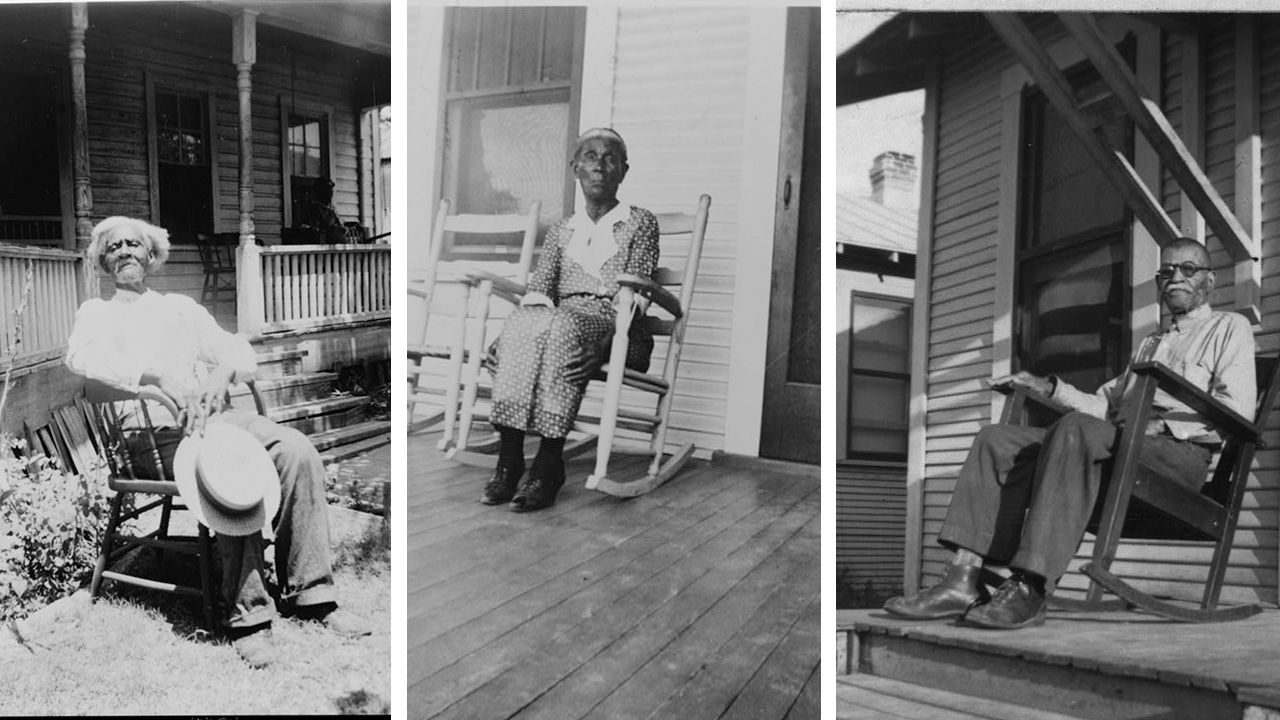
Stories of former San Antonio slaves live on in Library of Congress collection

William Branch was 11 when Union soldiers arrived to the Virginia plantation he was living in to tell him he was now free. James Green, who was kidnapped and sold back into slavery after he was emancipated, only learned his age when he was freed again at age 25. Martin Jackson was fighting the Union with his master when he realized the South would soon surrender.

The histories of these former San Antonio residents were among the thousands that were captured by the federal government in a collection of former slave narratives in the 1930s. The collection sheds light on a generation of Black Americans that are heavily overlooked in American history. Though some aspects of the narratives are problematic — almost every recorder was a white man, for example — the vast information still holds historical significance for the perspectives it chronicled.

In 1935, President Franklin Delano Roosevelt established the Federal Writers’ Project, a government-funded program that hired unemployed writers during the Great Depression. A year later, writers in Southern states began interviewing Black Americans who were born into servitude about slavery, which was ostensibly dismantled by 1865.

“(The narrative project began) roughly 70 years after the end of slavery, so I think people recognized that many of the former slaves are dying or dead so we should collect these things and learn more about them,” said Dr. Carey Latimore, an associate professor of history at Trinity University.

In two years, the writers amassed more than 2,000 interviews spanning 17 states, taking photographs and a few audio-recorded interviews along the way.

Previous slave narratives typically focused on those who made history, like Frederick Douglass and Henry Box Brown. But this collection was more unique, focusing on people who lived more average lives, covering Black history that might otherwise have been obscured.

“It’s valuable because these are people that would never have been interviewed for anything before,” Latimore said.

The inclusion of those voices was rare in its time, but historians agree the collection had built-in biases, as the interviews were primarily conducted by white men.

At the time, slavery was perceived in a gentler light, Latimore said, like an institution in which slaves and masters “had responsibilities to the other side.” Some of these writers descended from slave masters and Black people may have feared being honest to them.

“You can kind of get African-Americans struggling with that relationship throughout the interview and you can kind of feel how scared they may have been,” Latimore said.

As writers possessed varying amounts of talents, so did the narratives they produced. Some included more vivid details, while others were short and jumped from topic to topic.

Though writers were given a questionnaire to follow, the questionnaires were often ignored by the interviewers, according to the Library of Congress.

The majority of former slaves interviewed were also children when they were freed, which made their experience different and often less severe than adults who lived through it.

Despite those issues, “you have to recognize that this (collection) is so invaluable,” Latimore said.

“There’s no other opportunity to really glean that life and experience for average African-Americans,” he said. “And so even if it has issues, even if people are thinking about memories 70 years ago, you have to pay attention, you have to listen.”

The collection has been archived in the Library of Congress.

Read more on our Black history page:

KSAT Explains: San Antonio’s hidden Black history16 books about Black history you can read for free from the San Antonio Public LibraryWhat is Confederate Heroes Day and why do Texans still celebrate it today?Black History in San Antonio: the man behind the city’s MLK marchKSAT Q&A: History of Juneteenth in the U.S.

Meet San Antonio’s Poet Laureate Andrea ‘Vocab’ Sanderson

Editor’s Note: This story was first published in 2021.

For Andrea Sanderson, or “Vocab” as she’s known in the creative community, words have been a form of healing.

“The first time I read a poem in public was for a memorial service for a friend of mine that was murdered. And that experience really impacted me, seeing how people responded, seeing how poetry can be very healing and therapeutic kept me involved,” Sanderson explained.

Shortly after Sanderson started getting more involved in music and hip-hop, performing slam poetry and songs at open mics and poetry events. Born and raised in San Antonio, Sanderson began putting on events herself for her school and community.

“I threw a concert at my school gym, like hundreds of kids showed up. It was an amazing experience. And I realized how music in hip hop and poetry and all the rhythm and the rhyme and the cadence could really affect people even further,” she said. “And I just fell in love with it.”

Sanderson’s connections in the artist community eventually encouraged her to apply to be the city of San Antonio’s Poet Laureate, a role she sums up as “the ambassador for literacy and poetry in our local community.”

You can find Sanderson performing or promoting all things creative writing or performance at places like the Carver Community Center, Carver Branch Library and more. She is currently being featured in an exhibit titled, “The Glorious Way She Moves” at the Carver Community Center, which can be explored both virtually and in-person.

RELATED: Black community leaders in San Antonio behind evolution of Carver Community Center

Here’s what experts say you should do if your heat pump unit frosts over

First responders were not the only ones with a busy weekend due to wintry weather conditions. Workers in the HVAC (heating, ventilation, and air conditioning) industry had their hands full with several calls related to complications and concerns about home air conditioning and heating units.

One typical call during this type of weather deals with heat pump units frosting over.

“The ice will develop because of pressures,” said Manny Mallen, owner of Air Today Heating and Air. “Once your pressures start going down, that is when you will start having that frost buildup. It is typically normal when it does that, but if your unit has never frozen over before, you could have a potential problem. It could be low on refrigerant and could cause it to freeze over, like what happens in the summertime. When your AC unit freezes over, it is low on refrigerant. Vice versa in the winter — your outdoor unit can freeze over because it is low on refrigerant.”

Mallen said an easy fix would be to turn your thermostat on to emergency heat.

“It is better. Sometimes the thermostats do it on its own, but if your thermostat has the inability to put it on emergency heat, if the homeowner just put it on emergency heat, you should be fine,” Mallen said. “If it doesn’t have an emergency heat option, you can raise the thermostat up to three or four degrees, and usually, it will activate your accelerate heat.”

Mallen said another common question he gets asked deals with whether or not to get a carbon monoxide detector.

“Get a good quality carbon monoxide detector if you have a gas unit,” Mallen said. “The lower the detection, the better, because some of them start detecting at a higher level. And sometimes, once they start detecting, you are already experiencing symptoms of fatigue, dizziness, headaches and stuff like that, and you don’t even realize you are getting carbon monoxide poisoning.”

Mallen said another obstacle to consider is road conditions during winter weather when you are calling your HVAC service provider.

“A lot of service providers right now can’t drive in these conditions,” Mallen said. “It is hard to maneuver these big vehicles on ice. My guys couldn’t go to a home today. There was just a whole bunch of ice. We couldn’t even get to his home. We called him, and the owner was like, let me see outside, and he couldn’t even get out of his driveway, so we had to reschedule for another day.”

Like several other businesses, Mallen said his company is also adjusting its hours to operate safely.

He said to avoid spending $200-$500 for service calls at the last emergency minute, be sure to have your units checked twice a year. Call someone to come out once in the fall and again in the spring.

“We could potentially avoid problems like this,” Mallen said. “This is one of the biggest things where people do call their HVAC provider during bad weather conditions and say, ‘Can you come and make sure my unit is fine?’ A lot of this can be solved way ahead of time.”

Also on KSAT:

Go here for more winter weather stories.Go to the KSAT traffic page for the latest traffic conditions.Upload your weather pictures here.

How do conspiracies like QAnon go from fringes to forefront of social media? KSAT Explains

Editor’s note: The Nov. 30 KSAT Explains livestream features portions of a previously aired episode. You can watch it live at 7 p.m. in the video player above. After Tuesday night’s livestream, you will be able to watch the original version on demand.

An increase in political polarization. Mistrust in institutions. A huge megaphone provided by the internet. All of these factors have created an environment for conspiracies to run rampant.

Far flung and false ideas are no longer hidden in the far corners of the Internet. They are now discussed in mainstream media because belief in them has become so widespread.

SMART. IN-DEPTH. LOCAL: Click here for more episodes of KSAT Explains

In this episode of KSAT Explains, we took a closer look at this phenomenon underway across the United States and the recent surge of conspiracy theories. (Watch the full episode in the video player above.)

QAnon becomes mainstream

QAnon started with a simple post on an anonymous 4chan message board in 2017. It now has supporters from across the country.

“4chan is kind of a place where everyone’s anonymous. It’s like one of these free speech zones that just tolerates all sorts of hate speech and horrible kind of dirty memes and that kind of thing,” said Drew Harwell, Washington Post tech reporter. “At the time, back in 2017, it was sort of promising. It had this secret intelligence about Hillary Clinton being arrested for a lot of the same totally bogus claims that you had seen with Pizzagate and some of these other conspiracy theories.”

Those theories gained a national following that grew into what QAnon is today.

“QAnon on is a big bundle of sprawling conspiracy theories that are totally extreme and totally devoid of evidence, but what they say is that there’s this secret holy war being played out behind the scenes where there’s this cabal of satan worshiping, child trafficking, bad guys who also control the U.S. government, control the deep state, control the media, control the world,” said Harwell.

The sprawling conspiracy is now widespread. It’s being discussed on major social media platforms and in every day life.

“A lot of people who imagined a conspiracy theory think these are a bunch of lowlifes living in the basement, no social interaction, no job, that kind of thing. It’s a really easy stereotype to go to. It doesn’t seem to be true in this case. I’ve talked to men, women, college graduates, not college graduates, rural, urban. QAnon crosses all of those boundaries,” said Harwell.

In the video below, we look at QAnon’s impact on the presidential election, how tech companies were slow to react to its appeal and its growth out of the shadows of social media.

Rise in extremism culminates in U.S. Capitol attack

The U.S. Capitol siege in January shocked many people, but it was not a surprise to those who have been closely monitoring groups like QAnon for years.

QAnon is far from the only conspiracy theory surging. There’s been a growing trend towards extremism for years now.

“Extremism in U.S. politics and in our culture has been there for a long time,” said Peter Montgomery, senior fellow at People for the American Way. “What’s really different in the last several years has been the explosive power of social media to enable promoters of extremist ideology to find new recruits and to create communities of believers.”

In 2009, the U.S. Department of Homeland Security released a report warning that radical right wing extremism was on the rise in the country and it could lead to violence.

“There was a flourishing of new right wing coalitions that happened right after President Obama’s election,” said Montgomery. “People were willing to partner with folks that they might otherwise have kept their distance from because they saw him as such a threat to their conservative ideals about how the government should run or about who should be running the government.”

Over the past decade, it’s become increasingly difficult for authorities to pinpoint where the real threats online are coming from.

“Conversations that occur online that include a threat of violence obviously far outweigh the actual use of violence,” said Sam Lichtenstein, a global security analyst for Stratfor, a Rane Company. “It’s the proverbial needle in a haystack problem where you have all of these very loud signals that are constantly going on, but to actually find a signal amidst that noise is much harder.”

In the wake of a rise in extremist activity and consequences from the past year, many people are wondering what causes someone to become radicalized.

“Whether it’s deindustrialisation of people losing jobs or it’s the increasing ethnic, racial and religious diversity in the country that some people find very threatening because they have a view that the real America is white, Christian America,” said Montgomery. “Any of those kind of things that change people’s sense of comfort or safety can be exploited by people who want to promote ideologies of certain kinds.”

“They are searching for something in their social life and that sense of belonging, that sense of meaning,” said Lichtenstein. “And they find that in a world of other people that can help explain a very complex society in seemingly simplistic ways and basically say you are on the right side, you’re fighting against the evil side and kind of break down what are otherwise incredibly complex phenomenon.”

In the video below, we examine the rise of extremist groups online, how they have recruited more followers and the fallout of these ideologies that led to violent attacks like the El Paso shooting to the storming of the U.S. Capitol.

Social media censorship

Social media platforms have taken some action most notably after the riots at the Capitol.

They deleted certain accounts linked to false information, but it didn’t take long for people to argue the move was a violation of freedom of speech.

Most recently, a number of social media platforms banned former president Donald Trump’s and some of his allies after the insurrection at the Capitol.

The Pew Research Center said those media companies cited the belief that Trump’s posts violated their terms of use and that his rhetoric could possibly incite more violence.

As a liberal, I may have been relieved when they took away President Trump’s Twitter account at that particular moment,” said Aaron Delwiche, professor in the Dept. of Communication at Trinity University. “But Twitter could just as easily have been silencing somebody I agree with, so I really am uncomfortable with that precedent.”

Republican leaders like Florida gov. Ron Desantis said Silicon Valley tech companies are limiting the freedom of speech of conservative Americans. The Associated Press reported that some Florida lawmakers are now taking action against big tech.

These proposals range from forcing social media platforms to give users a months notice before their accounts are suspended or disabled to allowing consumers to sue if they feel they have been treated unfairly.

“On the one hand, you stop the spread of the information. That’s a good thing if it’s dangerous lies, but it also reinforces the narrative and the people who believe it. They say, ‘look, we’re onto the truth. It shows there’s a cabal out there that’s trying to silence us because they took away our Twitter accounts.’ It makes them martyrs and it kind of intensifies their feelings,” said Delwiche.

In the video below, we examine the debate over social media censorship and why purging the internet of bad information is not so straightforward.

How to battle misinformation

Bad information isn’t new, but many experts have noticed a growing trend in false claims being made that have become more widespread.

It’s usually centered around a major news event. As headlines about one topic or news event spread online, it is only a matter of time before that information is twisted into disinformation.

Battling that disinformation requires people to practice media literacy, which is being able to assess which news clips and stories we consume are trustworthy because it’s easier than ever for unreliable news stories to make their way into our social media feeds.

“You have to sort of feel the sense of responsibility that the information that you share could lead somebody to make a decision that could have really big consequences for their life,” said Tom Trewinnard, co-founder of FATHM, a company that KSAT partnered with in 2020 to create the Trust Index.

“Previously, you kind of had to search this stuff out,” said Mark Gifford, professor in the Writing Dept. at University of Texas at San Antonio. “If you wanted to find some weird stuff, you had to go on weird websites. You had to go on something awful dot com, you had to go in to kind of like the bowels of 4chan boards. Now this stuff that used to be on the periphery of the Internet has made its way into the largest social sites.”

Social media algorithms have also created what’s known as an echo chamber.

“If you’ve ever been to somebody’s house and you watch Netflix, you notice their Netflix looks nothing like yours. It’s a completely different set of choices that are presented,” said Renee Hobbs, director of the media education lab at the University of Rhode Island. “Being sensitive to that can really help us start to realize how our own choices are narrowing or shaping, creating those filter bubbles.”

In the video below, we examine what strategies can be used to battle disinformation, how to seek out trusted news sources and why this can be a polarizing topic among friends and family.